
When in Japan…
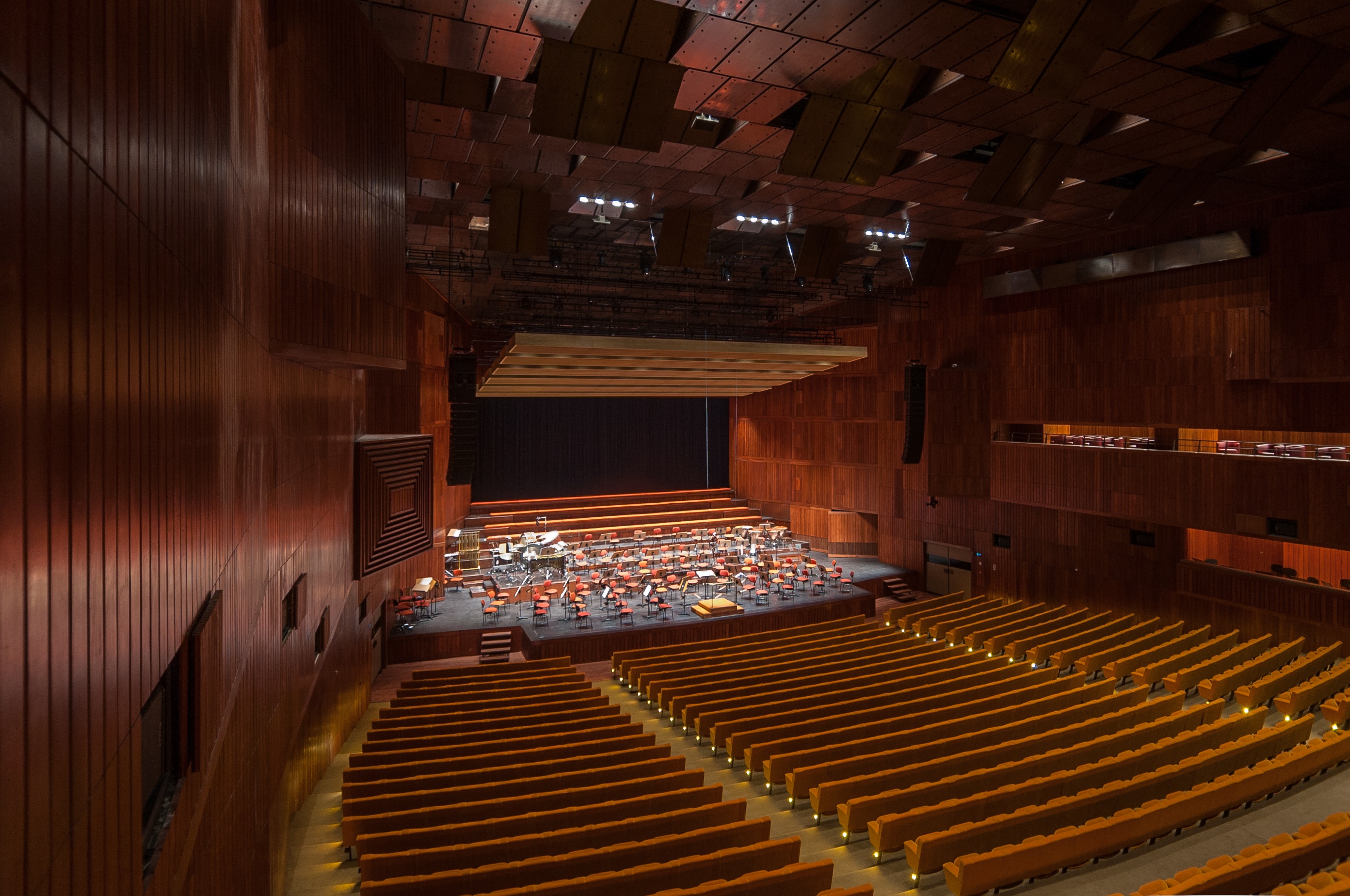
Gulbenkian Concert Hall
Are you a Wittertainee? I mean, of course, do you listen to Kermode and Mayo’s Film Review podcast from BBC 5 Live? I’ve been a devotee of the Church of Wittertainment (as their fans are known) for many years (hello to Jason Isaacs, by the way), long enough to remember way back when they first launched the renowned Wittertainment Code of Conduct for cinemas.
This started out as Mark Kermode’s and Simon Mayo’s not very serious response to the many emails from listeners about the increasing prevalence of bad behaviour in cinemas, but it quickly became something really quite significant. Our Screen Machine mobile cinema has a copy posted by the entrance, and a few years ago I was delighted to find a copy in a similarly prominent position in one of Berlin’s top cinemas. The Code starts obviously enough with prohibitions on talking during the film, or using your mobile phone, eating noisy food, or kicking the seat in front. But some items get a bit more esoteric, including: ‘No shoe removal: You are not in your own front room. Nor are you in Japan (unless you are, in which case, carry on).‘
That crack about Japan came back to me during our recent, and first, holiday in Lisbon, where we experienced not one, but two disconcerting examples of audience behaviour, and were left wondering whether each was considered in any way normal in Portugal, and , whether, therefore, we would have been wrong to make a fuss. In one case we did, in the other we didn’t. Was either decision correct? What is the etiquette when forming part of a foreign audience? When in Japan, should you take your shoes off (regardless of any resulting pungent odour)?
This all started a couple of months ago when, having booked our flights and hotel for Lisbon, I did what I always do on these occasions and searched for what concerts might be available while we were there. To my great excitement I found that the most exciting young pianist of the moment, Igor Levit, was going to make his Portuguese debut during our stay. Not only that, but he was going to be playing two of the works from his latest recording which had just won The Gramophone magazine’s Record of the Year Award. And to put the icing on the cake, the concert was in the Fundação Gulbenkian, just a short walk from our hotel.
As you can imagine, by the time we actually got to the concert hall, my anticipation was intense. The Gulbenkian concert hall is a lovely wood panelled space, seating, I guess, about 1200, and it was almost full, which was impressive for the demandingly intellectual programme on offer. We settled down to enjoy the immense hour-long journey that is Beethoven’s Diabelli Variations, and quickly appreciated that the hall’s acoustic was perfect for a solo piano. Unfortunately, it was also perfect for making clearly audible something much less uplifting: the utter barrage of coughing that broke out as soon as Levit’s fingers touched the keys, and which then persisted throughout the whole work. It was rare to get more than ten seconds of cough-free music. And it wasn’t just a few very sick individuals. Coughs resounded from every part of the auditorium. Several would go off at once. It was like trying to listen to a concert in the middle of a zoo, or the Gunfight at OK Corral (except that only lasted a few seconds…).
We really felt for Igor Levit. How he maintained his concentration, playing this Everest of the piano repertoire from memory, was a marvel to behold. As we discussed at the interval, if nothing else such behaviour (no one ever seemed to try to stifle their cough) seemed incredibly insulting to such a great artist. Yet at the interval the audience had given him a standing ovation! Perhaps that was just all the non-coughers acknowledging the scale of his achievement….
After the interval things did get better, partly because Frederick Rzewski’s equally monumental ‘The People United Will Never Be Defeated’ is a more torrential, acoustically overwhelming work than the Beethoven, and partly because some of the worst coughers seemed to have chosen to leave at the interval rather than expose themselves to a late 20th century masterpiece. But it was still much noisier than the average Moscow winter audience on old Soviet Radio relays from the 60s. I had thought of saying something to a member of staff at the interval, but in the end got cold feet—we were outsiders, after all. Perhaps this was normal, in Lisbon, in December.
Two evenings later we were at a free recital in the ornate Palàcio Foz in the centre of Lisbon, performed by the Trio Cremeloque, and taking a fascinatingly different approach to familiar Piano Trios of Beethoven and Haydn, with the usual violin and cello replaced by an oboe and bassoon. It was one of a regular series of free concerts, and the hall was packed. And even as the musicians started playing, several in the audience (all Portuguese) were busily photographing them on their phones. The middle aged man next to Judith even starting videoing the concert. This was too much. Judith gave him a sharp slap on the arm and he desisted—at least until the encore when the camera was out again, his raised arm blocking the view of those around him. Yet in between he had seemed intensely focused on the music. Once again the very fine musicians were given a standing ovation—which raised another unanswered question—are standing ovations the norm in Lisbon, rather than the very rare exception that they are in douce Edinburgh?
Lisboans, we found, are immensely welcoming, courteous and helpful people, and it was a delight to spend time among them. Indeed it is their very reticence and laid back character—certainly when compared with their counterparts in Madrid!—that made these two experiences seem, by contrast, so very odd. But maybe they would find the reverential behaviour of the average British classical music audience oddly cold and uninvolved. A mystery to solve—as if we needed an excuse to return to the delights of Lisbon!
Mind you, sometimes you can really get it wrong. Many years ago we went to a choral concert in Italy. We arrived, we thought, well before the advertised start time, only to find the Choir already on stage, singing away lustily. But the Italian audience was behaving atrociously: chatting loudly, moving about, even eating in some cases. We were stunned. Surely even Italians, we thought, couldn’t be this badly behaved as an audience. But then, after ten minutes or so, the choir all filed off stage. It turned out they were just doing their warm up. A few minutes later they returned in more formal manner, and their performance was then listened to in complete and attentive silence. And no one, as far as I could tell, took their shoes off.
© Robert Livingston December 2016
To Tweet or not to Tweet

We’ve been slow to catch up with the wave of live satellite relays now being offered by Eden Court. Last week, however, we made it to Rameau’s Hippolyte et Aricie from the Glyndebourne Opera Festival, and we found it an utterly engaging experience. In fact, I suspect that, for a very long and wholly unfamiliar Baroque Opera like this, the cinema experience might actually be the best way to see it for the first time, better even than being in the opera house itself. In the auditorium I could imagine my attention wandering during some of the long passages of declamation, but in the cinema, sensitive camerawork, and judicious use of close-ups, really drew us into the personal tragedies at the heart of the work. We did miss the champagne, though.
So, we’d give the whole experience a gold star, except for one really surprising element. As we in Inverness waited for the curtain to go up in Sussex, Glyndebourne regaled us with advertisements for future live relays (fair enough), and also with repeated injunctions to ‘get involved’ by tweeting during the screening! As avid fans of Kermode and Mayo’s Film Review on BBC Radio 5 Live, we were horrified at such a flagrant incitement to break the Wittertainment Code of Conduct. Needless to say no-one in the small but select Inverness audience did anything so crass.
The Code of Conduct started out, as many things do on this rather anarchic programme, as a joke between Mayo and Kermode, but it has been taken up by many cinemas around the world who see its ten rules, jokes aside, as simply good common sense for ensuring a pleasurable movie-going experience. For Glyndebourne to encourage its relay audiences to have their phones on at all, with all the light pollution that implies, and with the risk that not all of them will be set to ‘silent’, was really astonishing. I have written to complain!
But I think there’s a deeper philosophical issue here. ‘Get involved!’ exhorted the Glyndebourne advert, but surely, any audience member who is taking the time to compose and send a tweet is absolutely not involved in the gripping tragedy and the surreal spectacle unfolding on the screen. Certainly, over three hours and 45 minutes (including interval) I didn’t find my own involvement weakening for a moment, whereas during the film of Les Miserables a few weeks ago I was so bored I could have composed an entire novel in 140-character tweets.
The ‘involvement’ which Glyndebourne meant is social, not personal, and the two are not necessarily compatible. As someone who retains enough naivety to want to be made to laugh, cry, gasp and even hide behind the sofa while watching any drama, I do worry that there is a culture of objectivity and irony that is becoming all-pervasive. Why else do movie trailers now reveal almost the entire plot of a film, including the most exciting action sequences? Why does the Radio Times introduce each week’s new Dr Who monster before the new episode is screened? How else can perfectly normal people sit through such torture-porn movies as the Saw franchise? (I write as someone who nearly had to leave Pan’s Labyrinth at three different points in the movie, because of the violence.)
Mark Kermode even argues that it would be wrong to tweet or text during a film screening, even if you were the only person in the cinema, because it shows disrespect for the film-makers. While that rather Zen concept may be taking things a little far, I sympathise with his position. But we have to recognise that history is on the side of the tweeters. Gustav Mahler is credited with the practice of dimming the house lights during the overture of an opera, and then keeping them dim throughout the performance, and that was only at the start of the last century, when electric lighting made such an approach feasible, and it was initially resented by the audience. Prior to that, of course, the opera house was a place to go to see and be seen. French Grand Opera always had a ballet scene in the third or fourth act because that was when the members of the Jockey Club would turn up and expect to be able to see their favourite dancers. Hence, for example, the very rarely performed ballet scene in Verdi’s Otello. One doesn’t imagine the chaps from the Jockey arrived and left in sensitive silence.
It’s often said that it is unwritten codes of conduct that discourage many people from attending concerts, plays, opera and ballet: they’re worried about being made to look stupid because they might do the wrong thing—like applauding between movements. Yet the performers themselves can often be those who are most resistant to change. At the BBC Proms last week musicians were suffering from the heatwave, especially those involved in performing Wagner’s mammoth Ring cycle. In the liberal informality of the Proms, the audience could be in t-shirts and shorts, and several of them encouraged the musicians to discard their white ties and tails and do the same, but it’s the musicians themselves who defend their formal garb, saying it helps to create a sense of occasion.
And of course it is actors who are doing most to fight the menace of the mobile phone, often making up for the pusillanimity of theatre managements, as regular news reports testify Even more difficult is the situation of music venues that keep their bars open during the performance. A few years ago the great Steve Earle famously lost his temper at an Ironworks gig in Inverness, with a group of drinkers who would not shut up during his solo set.
So, am I making a Canute-like gesture in complaining to Glyndebourne? Should I accept that my wish to be profoundly moved, to be taken out of myself, to forget my surroundings, is the product of a relatively short period in cultural history, and that the tweeters, the chatterers and the drinkers are just the modern equivalent of the audiences that bought oranges from Nell Gwyn in 17th century London, or formed the notorious claque in 19th century Paris, or cheered on loquacious music hall MCs less than a century ago? Does the social trump the personal? Perhaps not. We’ve just been discussing how it no longer seems quite so cool to be ‘cool’, or an airhead, and that geeks and nerds are becoming more fashionable. So perhaps in future I may not need to long for the power of Ludwig II of Bavaria, who could command entire productions of Wagner’s operas for which he was the sole member of the audience. In the meantime, Glyndebourne really should think about adopting the Code.
© Robert Livingston
 the whole elephant
Recent Comments