
Durham doorcases
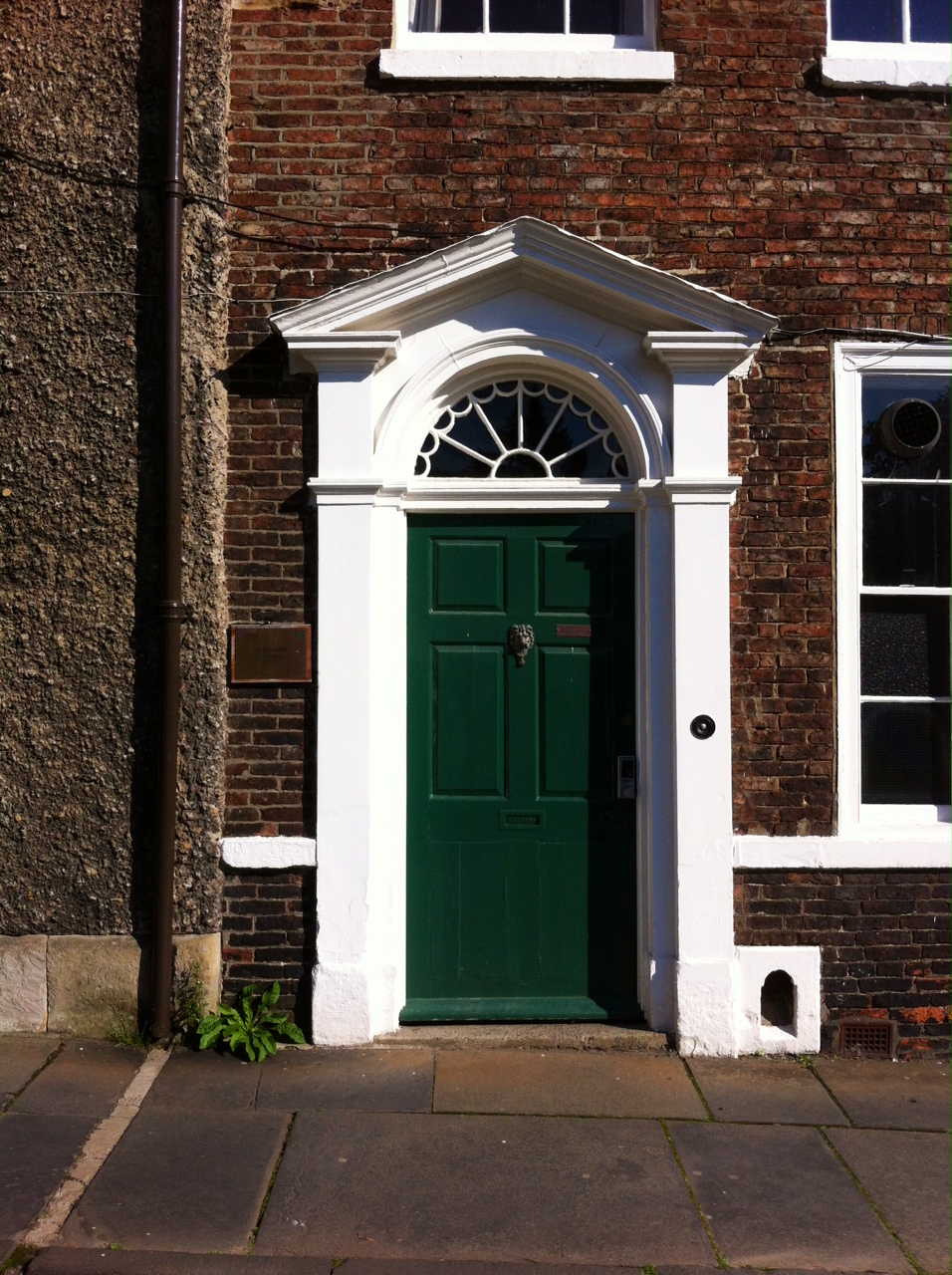
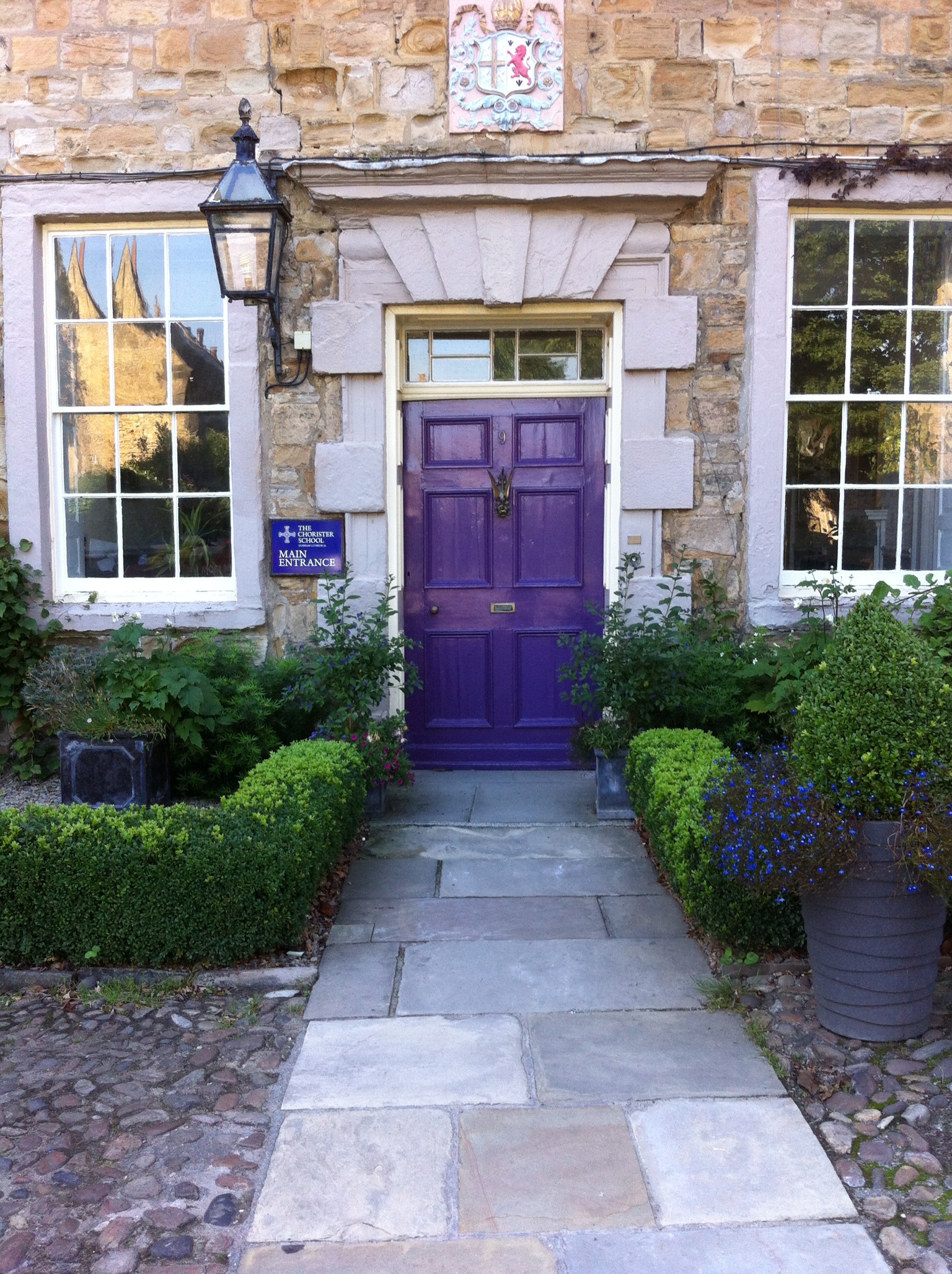
We’ve been in Northumberland all week, of which more later. Meanwhile, a visual blog: doorcases around Durham Cathedral close and the South Bailey:



The 70s, Part 1: Fringe Benefits
Rowan Atkinson
It’s almost exactly forty years since I got my first paying job in the arts, when, as a second year undergraduate, and by a complicated route, I had the great good fortune to fall into the post of classical music critic for the Glasgow Evening Times. So I think I’m justified in indulging in a bit of ‘now and then’ comparisons. Anyone with a strong aversion to nostalgia can skip this strand in the blogs. This week: how I covered the Edinburgh Fringe. All of it.
Getting that job at the Evening Times probably helped a lot three years later when, in 1976, as a new graduate, I applied, successfully, for a one year traineeship with BBC Radio, based in Edinburgh. At that time Scottish radio programmes were an opt-out from the Radio 4 UK schedules, and my primary job was as Research Assistant to a daily magazine programme, ‘Twelve Noon’ (guess when it was broadcast) which was the Scottish replacement for the then fledgling ‘You and Yours’. The last weeks of my contract coincided with the Edinburgh Festival. Now, while the ‘official’ Festival was covered by a weekly review programme, in that rather more ad hoc and informal environment the BBC Edinburgh team had no set formula for covering the Fringe, but decided that year that it should feature as a daily insert to ‘Twelve Noon’.
So, as a still wet behind the ears trainee, I was given a studio, a team of reviewers and a technician–all older and vastly more experienced than me–and told to provide ten minutes a day on the Fringe. I was editor, producer, scriptwriter, presenter, interviewer, and recorder of ‘live’ extracts, and there was no time for anyone more senior to check what I put together—the newly edited tape would simply be slipped into the programme’s running order just minutes before it was due to be aired. It was possibly the best fun I’ve ever had and been paid for.
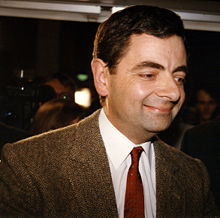
And that year, 1977, proved to be a vintage Fringe for new talent. We got a tip that the Oxford Revue was going to be worth checking out as, most unusually, it was a one man show. But then, that one man was a gangly, odd-looking young fellow whose memorably sardonic tone of voice constantly caught his audience off guard. His name was Rowan Atkinson. And he was unforgettable. That show we heard about just after it opened, but I also managed to get in and record an extract from what would be that year’s biggest hit, before it actually opened. Three of the actors from 7:84’s famous The Cheviot, the Stag and the Black, Black Oil –Bill Paterson, John Bett and Alex Norton—were reuniting to stage the first play by the artist who had created the memorable ‘pop-up book’ set for the Cheviot. The artist was John Byrne, the play was Writer’s Cramp, and the rest is history. By a happy coincidence, the play is being revived for the first time in many years for the Lennoxlove Book Festival in November.
Another of the hits of that 1977 Fringe was revived at last year’s Fringe. Glasvegas – a comedy musical and nothing to do with the indie band of the same name—launched the careers of its creators, writer and director Morag Fullerton, and composer and sometime actor, Pat Doyle, who, by another coincidence, would go on the following year to play Hector in John Byrne’s next play, The Slab Boys. In the 80s, as Patrick Doyle, he would become house composer for Kenneth Branagh’s Renaissance Theatre Company, and via Branagh’s film of Henry V, go on to become one of Hollywood’s most talented and successful film composers.
Both last year and this, the media, online and in print, have been full of op-eds about whether the Fringe has become too big, and also too expensive both for participants and for ticket-buyers. Certainly, I’d be very interested to know if anyone has any views on whether new talent like John Byrne, Morag Fullerton and Patrick Doyle would get spotted in today’s Fringe, without the benefit of the media interest that inevitably attaches, for example, to new acts coming out of Oxford or Cambridge.
I’m pretty sure that it would be very hard, if not impossible, to do now what I went on to do in 1980, which was to put together a company of student and aspiring actors for that year’s Fringe. We were facing a number of obvious disadvantages: I had chosen to stage the English language premiere of a play by the ‘Spanish Shakespeare’, Calderon de la Barca: The House with Two Doors. At that time, prior to high profile productions at the National and the RSC, Calderon’s name was barely known outside academic circles. But I had a good friend, John Clifford, who was a Spanish Golden Age specialist and very interested in translating Calderon for the stage. Our venue wasn’t the most prominent: a school hall near the Art College, some distance from the gravitational centres that were already emerging among Fringe venues. And of course the actors were all complete unknowns. My only ‘name’ was the composer and Whistlebinkie Eddie McGuire–I had got a Scottish Arts Council grant (yes, a grant!) to commission him to write the incidental music.

The House with Two Doors
Yet over a two week run we averaged around 30 paying customers a night, got two decent reviews (one in the Scotsman), and the whole venture only cost me £200—say two thousand in today’s terms . Worth every penny. John (now Jo) Clifford went on, of course, to become one of Scotland’s most prolific and internationally-recognised playwrights. Several of the cast became professional performers, one later joining the BBC Radio Repertory Company. Our make-up artist has gone on to have a successful career in TV and Film make-up. And as for the builder of the eponymous doors—Reader, I married her.
© Robert Livingston
Rambling on Bute
Kilchattan Bay
Are you a tourist or a visitor? Do you like to be part of an organised group, plan your own itinerary in meticulous detail, or be spontaneous and leave everything to chance and the whim of the day? I was back on Bute this week, for a meeting that helped to move forward the slow process of planning the redevelopment of Rothesay Pavilion, and with some time to spare, I decided to play the tourist.
It was a morning meeting, so I had stayed the night before in Rothesay, at the Glendale, a comfortable, modestly-priced and, architecturally, wonderfully eccentric guest house, where, for breakfast, I partook of brioche with creamy scrambled eggs and smoked salmon. Smashing.

Winter Gardens, Rothesay
Having arrived at around 8.00 on a pleasant and dry evening, I had gone for a walk along the front. Now, the front at Rothesay should be celebrated as one of Scotland’s small glories. An unbroken walkway stretching for miles, from north of Port Bannatyne right through Rothesay to its southernmost tip, it has, to the seaward, the unmatchable view across to the Cowal Peninsula and the hills of south-east Argyll and, to the landward, a long line of the most delightfully diverse vernacular architecture, with many of the larger villas having fine gardens to their front. And in the centre of Rothesay there are the glories of the Winter Gardens (their fabric sadly looking rather the worse for wear) and their flowerbeds, and, of course, the finest Gents’ lavatories in the country (I can’t speak for the Ladies). Rather like at Nairn Beach, I don’t imagine that walking the front at Rothesay is a pastime of which one would tire quickly.
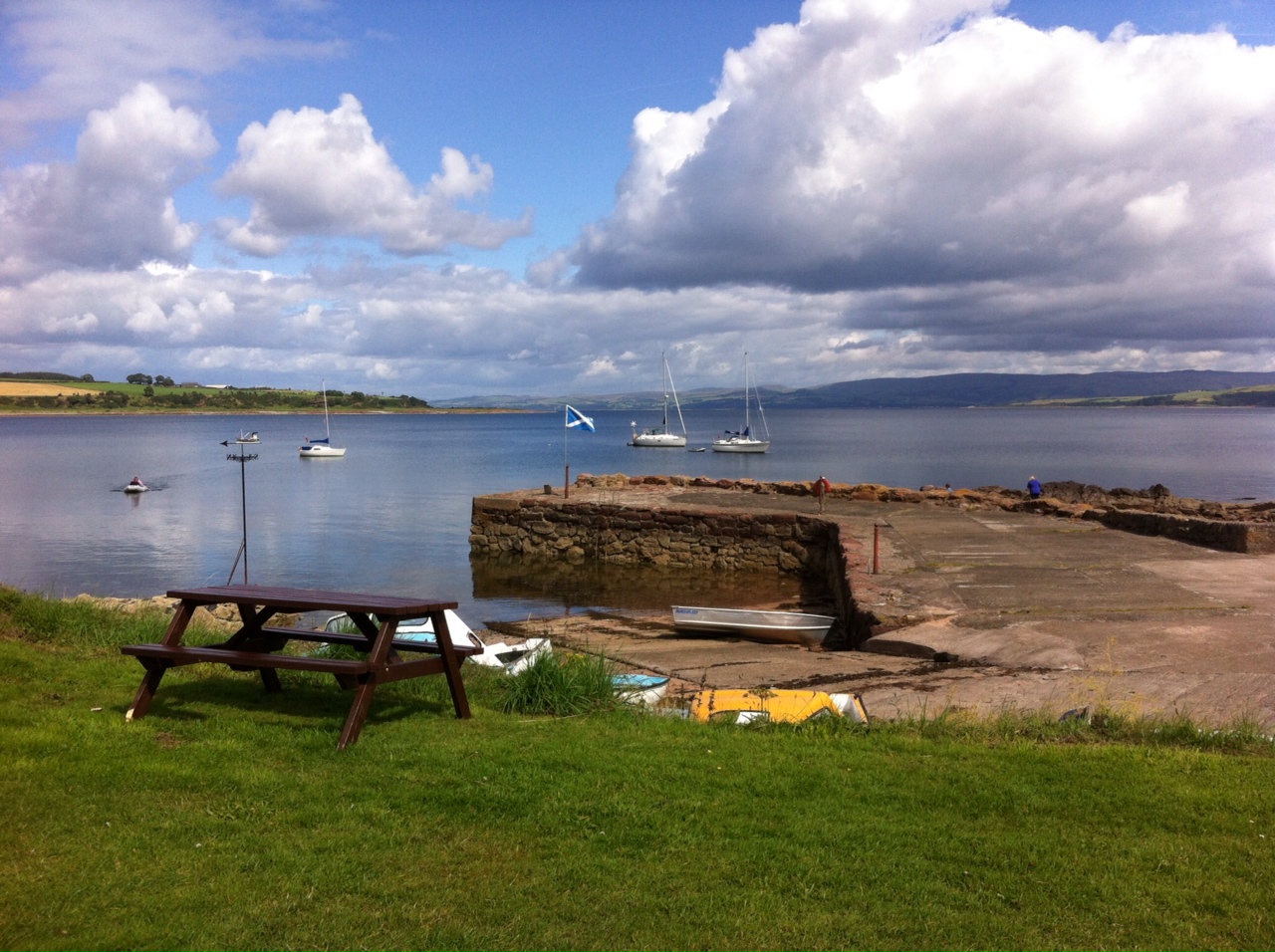
My meeting was over by lunchtime, so I bought a picnic and drove down to Kilchattan Bay, which I had last visited when I was eleven years old, and I had spent an idyllic week with my mother on a farm holiday there. It’s still idyllic, especially as the weather was positively Mediterranean, and it has a quiet peace that, oddly, reminded me of South Ronaldsay at Scotland’s other extremity. Then on to the picturesque ruins of St Blane’s Church, up the west coast to Ettrick Bay, and across to Rhubodach and the ferry back to the mainland, and the long drive north.

Dunagoil Hill Fort
Now, here’s where the paradox comes in. At each place I stopped I was just able to squeeze my little Peugeot into the last parking space—at Kilchattan bay, and at the roadside bays for the hillfort at Dunagoil, and St Blane’s Church. And at all of these locations the special quality of the experience would have been marred if there had been many more visitors—especially a large coach party. At a different scale, something of the same is true at Bute’s largest visitor attraction, Mount Stuart (subject of an earlier blog): it’s in the nature of the house that visitors have to be guided round in small groups, and in high season the numbers going round could probably only be increased by extending the opening hours, the extra income from which might be outweighed by cost.
Yet, in the middle of August, my very pleasant and well situated guest house still had vacancies. On the other hand, those who organise events on the island tell me that Bute doesn’t have enough bed spaces to meet existing demand at times like the Jazz Festival, never mind an increased demand that might be occasioned by new events at a refurbished Pavilion. And nor is the existing accommodation of the type that would attract back to a rebuilt Pavilion the large conferences—especially party political conferences—which the building used to host in its heyday. This is in part due, I’m told, to the number of hotels which, in recent years, have been turned into flats or left derelict.
So, if Bute is going to increase its prosperity, it would seem that it can only do so by increasing the number of visitors, even in high season, and consequently providing more and different accommodation. Yet this risks killing the goose that lays the golden eggs. As I found in my short trip, Bute offers the visitor an exceptional range of experiences in a small compass, but those experiences are very different from those of the days of going ‘doon the watter’: they favour the independent traveller, not organised mass tourism. I think I’m rather falling for Bute, and not just its landscape: its folk are cheerful and welcoming, but also energetic and enterprising. The island has tremendous potential: we all need to ensure that in trying to realise that potential, we don’t mar rather than make better.
© Robert Livingston
Pittenweem and the Working Class Playwright
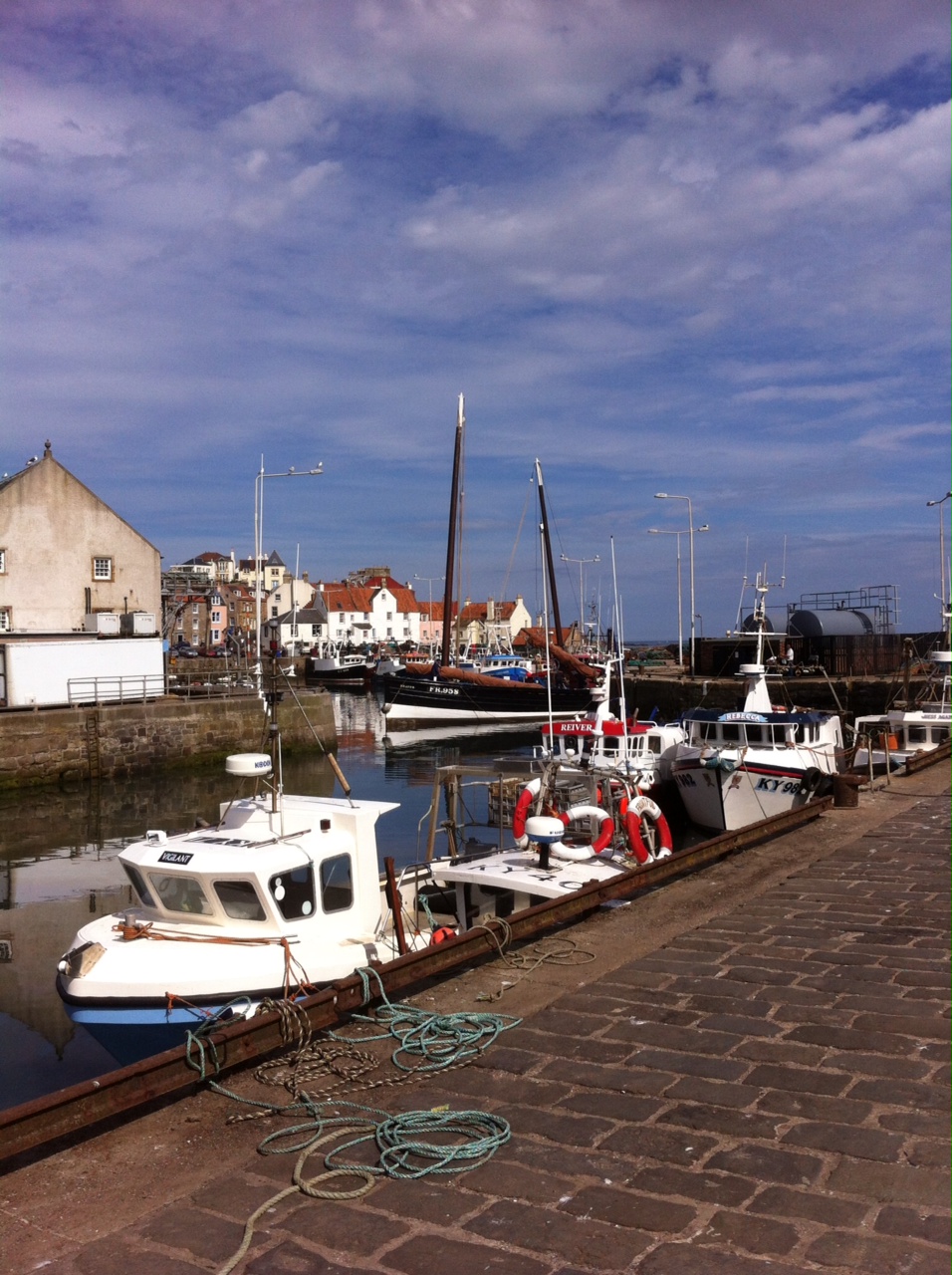
The ‘Reaper’ in Pittenweem Harbour
I don’t often find myself linking Pittenweem and Monty Python, but our visit to the Pittenweem Arts Festival this week brought to mind that great Python sketch Working Class Playwright . It goes like this: Eric Idle (long hair, suit, posh accent) is the son returning to his Hampstead home, which he left to become a coal miner ‘up north’, against his father’s wishes. The father is Graham Chapman (collarless shirt, braces, boots, cod working class accent) who has stayed at home to follow the demanding calling of being a working class playwright, getting up at five, and attending premieres and gala dinners. He suffers from agonising writer’s cramp, and berates his son for choosing the soft option of coalmining, dismissing him, unforgettably, as ’you tit!’, to which the son responds that ‘there’s more to life than culture!’.
Recalling this sketch is the best way I can pin down the very slight queasiness that I felt during an otherwise wonderful couple of days at the Festival, a life-enhancing experience greatly helped by the gloriously summery weather. We lived in the neighbouring village of Anstruther from 1984 to 1996, and have returned to the East Neuk frequently ever since, and so we know Pittenweem very well. Indeed, Judith and I both played small parts in the early days of the Festival, back in the late 80s. When we finally moved permanently to the Highlands in 1996, both Anstruther and Pittenweem were pretty depressed communities, affected badly by the shrinking fishing industry. It took two years to sell our handsome Edwardian semi, and even then it went for a fixed price. There were many empty shops and derelict premises in both villages.
Anstruther has been saved, in part, like so many former fishing villages, by the introduction into the old harbour of marina pontoons, which have attracted so many boats that the system is now being extended, and the front at Anstruther now boasts three fish and chip shops, all, at busy times, with lengthy queues. Pittenweem, on the other hand, has been saved by Art. When the Pittenweem Festival started out in the 1980s, I’m sure no-one expected it to become the mega-event it is today, with around 100 artists and makers exhibiting for ten days throughout the village. This year’s event seems to have been particularly successful: the large festival car park was almost full on both days we were there, and almost every exhibition we visited (about a third of the total!) sported a healthy rash of red dots. It’s estimated that it brings £1.5 million to the local economy—a lot for a community of just 1800 people.
And, of what we saw, we found the standard to be very high. If there was nothing quite as unforgettable as last year’s installation of Jake Harvey’s sculptures in the little Old Men’s Club, there was a great deal of work that was accomplished, engaging and inspiring. The Festival also deserves praise for the quality of its organisation, from the parking stewarding to the signposting, and from the festival catalogue to the programme of related events. Best of all everyone—volunteers, artists, catering staff–was unfailingly cheerful and welcoming, showing few signs of fatigue, six days into the festival!
So, why that slight queasiness? Well, Pittenweem is still the most active fishing port on the Fife Coast, with a large number of boats going after shellfish, lobsters and clams. The harbour is often very busy, with a handsome Fishmarket that was built as recently as 1994, and a number of related businesses in the town itself—fishmongers, chandlers and the like. But it seems to be the art that has brought prosperity back to the village: several galleries, studios, and art materials shops, many working artists living in the village, a number of apparently thriving cafes and restaurants. All the evidence, that is, of gentrification.
Other East Neuk villages—Crail, Elie–long since succumbed to such gentrification, and possess little or no local industries, Elie in particular being dominated by holiday homes, while Crail has seen, in recent years, a drastic decline in local retail businesses. Can Pittenweem continue to resist this process and retain a degree of authenticity as a working village? Or is my wish for such ‘authenticity’ just another part of the gentrification process, wanting the undeniable picturesqueness of the harbour area to remain based in genuine working practices, and not simply maintained in some shadowy form for the sake of tourists? Is it my own sense of queasiness that I’m trying to assuage in wanting evidence that, for Pittenweem, ‘there’s more to life than culture’?
Although there are inevitably some dissenting voices, arguing that the Festival has become too commercial, too exclusive, and doesn’t put enough back into the community, a 2012 household survey by Pittenweem Community Council, with a healthy 17% response rate, found 76% of respondents had been to and enjoyed the Festival, and only a small minority had any negative comments to make. So maybe the two worlds of fishing and art can successfully co-exist.
Pittenweem is a very important test case for the role of the arts in community regeneration, for a number of reasons: the Festival was a truly local initiative, unprompted by any external strategies or incentives; it has always had both artists and representatives of local businesses working together at its core; it needs very little public funding (and currently gets none from Creative Scotland), and it is a survivor, growing and developing over a 30 year period. But, as the excellent Radio 4 programme More or Less is always reminding us, ‘correlation does not imply causation’, and we should not leap to the immediate conclusion that Pittenweem’s current prosperity is rooted in the creative economy, nor even, if it is, that this is a replicable model.
The fact is that Pittenweem’s long and complex history has resulted in a very special built environment, and one of the great pleasures of the festival is being able to view parts of that environment that are usually private, or to gain, from those private settings, unexpected perspectives of familiar sights and buildings. Any study of the impact of the arts in Pittenweem, therefore, can’t just look at the economics involved, but would also have to take account of these more intangible factors. At the end of five hours of exhibition-visiting, eyes narrowed in the glow of the late afternoon August sun, head full of images, I began to find it hard to avoid the feeling that I was moving through some sort of dreamscape, as I caught an unexpected glimpse of a shimmering Bass Rock at the end of a narrow wynd, or came across the 110-year old ‘Reaper’ , a Fifie-class drifter from the Anstruther Fisheries Museum, making its way out of the narrow harbour mouth.
There’s an underlying truth to the Python sketch with which I started: making art may very rarely be as physically arduous or dangerous as the fishing industry (or coal mining!) but nor is it, for those who are really serious about it, a soft option either. The financial rewards can be too often entirely disproportionate to the mental and physical efforts involved. The Pittenweem Arts Festival, above all, celebrates artists, and that can’t be a bad thing!
© Robert Livingston
A Good Read
One of the drawbacks of working from home is that I no longer get to listen to downloads of Radio 4 programmes while driving to and from work each day, and so I’ve accumulated a substantial backlog on my MP3 player. Fortunately, though, I had to drive to Rothesay this week, a round trip of some 12 hours, and so I have caught up substantially through listening to multiple episodes of Feedback, Last Word, Saturday Review, More or Less, Counterpoint, The Life Scientific and, a particular favourite, A Good Read, with the estimable Harriet Gilbert.
My interest in Ms Gilbert is not just that she’s an excellent and quirky presenter, skilled at drawing out the views of her guests, but also that she’s the daughter of one of my favourite neglected authors, the crime- and thriller-writer, Michael Gilbert.

Michael Gilbert enjoyed a very long life—he died in 2006 at the age of 93—and a similarly long writing career, publishing his first novel in 1948 and his last in 1999. That means he was a contemporary of much better-remembered writers such as Michael Innes and Edmund Crispin, as well as overlapping with the later careers of such eminent figures in the crime and thriller worlds as Margery Allingham, Eric Ambler, and, of course Agatha Christie. I think he’s as good a writer as any of those famous names, and better than some of them, but, curiously, the very qualities for which I admire him may be the factors that have led to his neglect.
First, he didn’t stick to one genre, but wrote detective novels, thrillers, and espionage fiction. And he didn’t hesitate to mix genres. I’m currently reading one of his most acclaimed books, Death in Captivity from 1952, which is a murder mystery set in a POW camp in Italy and based directly on Gilbert’s own wartime experiences: it was made into a film in 1958. Previously I’d read The Empty House of 1978 which starts out as a murder mystery and turns into a spy thriller. Its innocent hero is thrust into a world whose cynicism, ruthlessness, and disregard for the law strike a remarkably contemporary resonance. It’s an absolute page-turner.
And then, although some of his central characters do reappear in several titles, none of them achieved the fame—or notoriety—of an Albert Campion, a John Appleby, or a Hercule Poirot. That of course left Gilbert free to tell the stories he wanted to, without being shackled by readers’—and publishers’—expectations, but it also militated against his books becoming really popular, and his characters lasting in the collective memory. Just as with his cross-genre plots, Gilbert often compounded this characteristic by writing stories which had no one central character, but instead multiple viewpoints. That makes for an exhilarating, but also a more demanding, read.
Finally, although his books can have a whimsical tone (Smallbone Deceased) that is reminiscent, say, of Edmund Crispin’s The Moving Toyshop, or a boy’s-own-adventure quality (The Etruscan Net) comparable to Michael Innes’s wonderful The Journeying Boy, all those I’ve read, no matter how fantastical their plots, have an underlying toughness and realism that prevents them from offering a cosy nostalgia for the innocent days before Prime Suspect or The Killing.
One thing that Michael Gilbert does share with his genre contemporaries is that his books are short—rarely exceeding 250 pages. His story-telling is wonderfully terse and economical: the opening chapter frequently throws the reader in media res, with setting and character introduction following later. That’s a virtue we need to rediscover. I remember the wise and canny editor and literary agent John Jarrold telling budding SF writers that their books needed to be 400 pages long to meet publishers’ demands, as it seems readers today measure a book’s value by its length as much as, or more than, by its quality. The result is too often padded, if not bloated, and has resulted in the ruination of many previously fine genre writers.
So, again unlike Allingham or Christie, Michael Gilbert’s name has not been revived through regular TV and radio adaptations, and as a result most of his books have been out of print for many years—so many years that they now rarely surface in charity shops, so obsessed are those enterprises with only the latest bestsellers, nor in libraries where older copies have long since worn out. But technology has come to Gilbert’s rescue. A huge number of his titles are now available in Kindle editions, while battered copies of those old paperback editions can be ordered from online sites like Abe Books for a pittance.
So I’m glad to say you have no excuse for not discovering Michael Gilbert’s merits for yourself—he really is A Good Read.
© Robert Livingston
To Tweet or not to Tweet

We’ve been slow to catch up with the wave of live satellite relays now being offered by Eden Court. Last week, however, we made it to Rameau’s Hippolyte et Aricie from the Glyndebourne Opera Festival, and we found it an utterly engaging experience. In fact, I suspect that, for a very long and wholly unfamiliar Baroque Opera like this, the cinema experience might actually be the best way to see it for the first time, better even than being in the opera house itself. In the auditorium I could imagine my attention wandering during some of the long passages of declamation, but in the cinema, sensitive camerawork, and judicious use of close-ups, really drew us into the personal tragedies at the heart of the work. We did miss the champagne, though.
So, we’d give the whole experience a gold star, except for one really surprising element. As we in Inverness waited for the curtain to go up in Sussex, Glyndebourne regaled us with advertisements for future live relays (fair enough), and also with repeated injunctions to ‘get involved’ by tweeting during the screening! As avid fans of Kermode and Mayo’s Film Review on BBC Radio 5 Live, we were horrified at such a flagrant incitement to break the Wittertainment Code of Conduct. Needless to say no-one in the small but select Inverness audience did anything so crass.
The Code of Conduct started out, as many things do on this rather anarchic programme, as a joke between Mayo and Kermode, but it has been taken up by many cinemas around the world who see its ten rules, jokes aside, as simply good common sense for ensuring a pleasurable movie-going experience. For Glyndebourne to encourage its relay audiences to have their phones on at all, with all the light pollution that implies, and with the risk that not all of them will be set to ‘silent’, was really astonishing. I have written to complain!
But I think there’s a deeper philosophical issue here. ‘Get involved!’ exhorted the Glyndebourne advert, but surely, any audience member who is taking the time to compose and send a tweet is absolutely not involved in the gripping tragedy and the surreal spectacle unfolding on the screen. Certainly, over three hours and 45 minutes (including interval) I didn’t find my own involvement weakening for a moment, whereas during the film of Les Miserables a few weeks ago I was so bored I could have composed an entire novel in 140-character tweets.
The ‘involvement’ which Glyndebourne meant is social, not personal, and the two are not necessarily compatible. As someone who retains enough naivety to want to be made to laugh, cry, gasp and even hide behind the sofa while watching any drama, I do worry that there is a culture of objectivity and irony that is becoming all-pervasive. Why else do movie trailers now reveal almost the entire plot of a film, including the most exciting action sequences? Why does the Radio Times introduce each week’s new Dr Who monster before the new episode is screened? How else can perfectly normal people sit through such torture-porn movies as the Saw franchise? (I write as someone who nearly had to leave Pan’s Labyrinth at three different points in the movie, because of the violence.)
Mark Kermode even argues that it would be wrong to tweet or text during a film screening, even if you were the only person in the cinema, because it shows disrespect for the film-makers. While that rather Zen concept may be taking things a little far, I sympathise with his position. But we have to recognise that history is on the side of the tweeters. Gustav Mahler is credited with the practice of dimming the house lights during the overture of an opera, and then keeping them dim throughout the performance, and that was only at the start of the last century, when electric lighting made such an approach feasible, and it was initially resented by the audience. Prior to that, of course, the opera house was a place to go to see and be seen. French Grand Opera always had a ballet scene in the third or fourth act because that was when the members of the Jockey Club would turn up and expect to be able to see their favourite dancers. Hence, for example, the very rarely performed ballet scene in Verdi’s Otello. One doesn’t imagine the chaps from the Jockey arrived and left in sensitive silence.
It’s often said that it is unwritten codes of conduct that discourage many people from attending concerts, plays, opera and ballet: they’re worried about being made to look stupid because they might do the wrong thing—like applauding between movements. Yet the performers themselves can often be those who are most resistant to change. At the BBC Proms last week musicians were suffering from the heatwave, especially those involved in performing Wagner’s mammoth Ring cycle. In the liberal informality of the Proms, the audience could be in t-shirts and shorts, and several of them encouraged the musicians to discard their white ties and tails and do the same, but it’s the musicians themselves who defend their formal garb, saying it helps to create a sense of occasion.
And of course it is actors who are doing most to fight the menace of the mobile phone, often making up for the pusillanimity of theatre managements, as regular news reports testify Even more difficult is the situation of music venues that keep their bars open during the performance. A few years ago the great Steve Earle famously lost his temper at an Ironworks gig in Inverness, with a group of drinkers who would not shut up during his solo set.
So, am I making a Canute-like gesture in complaining to Glyndebourne? Should I accept that my wish to be profoundly moved, to be taken out of myself, to forget my surroundings, is the product of a relatively short period in cultural history, and that the tweeters, the chatterers and the drinkers are just the modern equivalent of the audiences that bought oranges from Nell Gwyn in 17th century London, or formed the notorious claque in 19th century Paris, or cheered on loquacious music hall MCs less than a century ago? Does the social trump the personal? Perhaps not. We’ve just been discussing how it no longer seems quite so cool to be ‘cool’, or an airhead, and that geeks and nerds are becoming more fashionable. So perhaps in future I may not need to long for the power of Ludwig II of Bavaria, who could command entire productions of Wagner’s operas for which he was the sole member of the audience. In the meantime, Glyndebourne really should think about adopting the Code.
© Robert Livingston
The Problem with Poussin

Nicolas Poussin
Living in the Highlands, there’s very little that we miss about the Central Belt, except for the chance to see major art exhibitions. The team at Inverness Museum and Gallery often achieve wonders with their limited resources, but that doesn’t remove the need for a regular fix—usually in Edinburgh, as Glasgow has fallen badly behind ever since the magnificent MacLellan Galleries were mothballed.
One of the early tasks I was given on joining HI~Arts in 1994 was to write the brief for the very first formal feasibility study into creating a major gallery for the Highlands and Islands. I used to hope then that I’d see such a gallery open before I retired. Now it’s only the shifting ages for claiming the state pension, and the poor state of my personal pension, that are keeping that possibility even remotely open.
In the meantime Edinburgh can still offer some fantastic exhibition experiences, especially through the National Galleries and Museums. We always make sure we get down for the Festival exhibitions, so we were initially disappointed that, having to be in Edinburgh for a meeting last week, we were just too early for most of those blockbusters. But that turned out to be a blessing in disguise.
In the first instance, this encouraged us to visit the kind of lesser display that can so easily get overlooked when the great crowd-pullers are open, Through American Eyes: Frederic Church and the Landscape Oil Sketch . Not the most stimulating of titles, perhaps, but this proved to be the kind of small but perfectly formed exhibition which, in just one room and some 25 small pictures, can be both a revelation and a source of intense pleasure. Frederic Church is known here (insofar as he’s known at all, that is), for the Scottish National Gallery’s epic Niagara Falls from the American Side but this exhibition showed his miniature side, and what an incredible eye and technique he had. The exhibition is on till April next year, so you’ve no excuse if you miss it! And it’s free!
And better still, on the way to see the Church exhibition, we stepped into the little hexagonal room on the ground floor of the National Gallery that is the permanent home for seven of the greatest paintings ever created—perhaps the greatest paintings in any collection in Scotland: Nicolas Poussin’s Seven Sacraments. Now I’ve known these paintings all my adult life, and had we been trying to fit in various exhausting major exhibitions on this trip, we’d hardly have spared the time to revisit them, which would have been a shame, as I found the experience very moving.
How can I persuade you of the true greatness of these paintings? It’s not an easy task. Unless you’re a fairly well briefed member of the Catholic Church, the subject matter is obscure, not to say recondite, and not immediately easy to relate to. Then, the paintings are now mostly very dark, due presumably to aging varnish and a certain amount of fading pigments, and so don’t make an immediate impression on the viewer. And, most significantly, these are supreme examples of French Classicism, contemporary with the plays of Racine, the music of Lully, and the first phase of building at Versailles—a style, a philosophy, a world, that are probably as far from contemporary taste as anything in the last half-millennium.
Even as an art history student I didn’t take readily to Poussin; in fact I think I graduated without really understanding his achievement. I was put off by the solemnity of his religious subjects and, paradoxically, by the frivolity of many of his mythological themes. It took a lot of looking, and some great exhibitions, including the Scottish National Gallery’s own landmark Cezanne and Poussin of 1990, to change my mind. And I clearly wasn’t alone in having this problem: researching this blog I was amused to find a 2009 Guardian article titled ‘Arts snobs can keep Poussin’.
Well, maybe I am an art snob, but my admiration for Poussin now goes well beyond the intellectual or the academic. I quite simply love his paintings, as profoundly as I love the music of Bach, or the poems of John Donne, to mention two other artists in other artforms who can be thought ‘difficult’. Let’s return to the Sacraments, and look at just one of them, Holy Eucharist.

Poussin: The Sacrament of Holy Eucharist
Forget Leonardo, this is the ‘Last Supper’, not least because it makes such a concerted attempt to re-imagine the scene, starting with having the apostles, in a historically correct manner, reclining on couches on three sides of a table, rather than lined up all in a row. Yet there are still hurdles to overcome. Historically correct the scene may be in one sense, but hardly for a bunch of Galilee fishermen in an ‘upper room’. Christ at first sight seems too idealised, while too many of the apostles’ heads seem to have the rigidity of classical tragic masks. But set that to one side: look at how naturally everyone is posed, and look especially at their reactions. Jesus has obviously just announced ‘One of you will betray me’ and many of the apostles are caught literally with their mouths full, or with the next bite half way to their mouths. It has the vivid immediacy of a film still, an effect enhanced by the astonishing lighting from the central (and again archaeologically correct) hanging lamp, and especially by the figure of Judas, slipping out to the left.
But these elements are easy to describe. What’s much harder to convey is what makes Poussin really great—a pervasive and intense sense of human empathy that, curiously, is heightened, not diminished, by the classical manner, and a truly musical sense of form and structure. Goethe called architecture ‘frozen music’ but I think the phrase could equally be applied to Poussin—after all one of his most famous paintings is A Dance to the Music of Time!
So, the only way to ‘get’ Poussin, I’d argue, is to look, look, and look again, and keep coming back. The rewards repay the effort. And so the real problem with Poussin is that he demolishes two arguments that are increasingly gaining ground: that art should be easily (if not instantly) accessible, and that art, especially of this kind, is elitist and those who want to enjoy it should pay for their pleasure. Good art takes time, and that’s why galleries need to be free. And why we need a really good one in the Highlands!
© Robert Livingston
Towns: the Final Frontier
Are you a Trekker? If so, which Star Trek series do you prefer? Although I can’t avoid feeling nostalgia for the original Shatner/Kirk series with which I grew up, I do have to admit it now looks pretty creaky, and I prefer its sequel, Star Trek: the Next Generation, chiefly due to the admirable character of Captain Jean-Luc Picard, played with such quiet authority by Patrick Stewart.

Mind you, I was already a Patrick Stewart fan. As a schoolboy I had been taken to Stratford (overnight coach both ways!) to see Richard III, and in a powerhouse RSC cast that included the late Norman Rodway and Ian Richardson, and a luminous Helen Mirren, the youthful but already balding Stewart had held his own as an actor of real presence and integrity, qualities that have sustained his entire career.
He popped up in a different role on our TV last week, as we caught up with recordings Nicholas Crane’s second series of ‘Town’. This episode was on Patrick Stewart’s home town of Huddersfield, where he has been Chancellor of the University since 2004, and by the time he appeared towards the end of the programme, extolling both town and university, we were ready to cheer him on. In fact, Crane had presented such an inspiring picture of the architecture and the people of Huddersfield that we were ready to jump on the next train south and remedy a lifetime’s neglect by finally visiting the town.
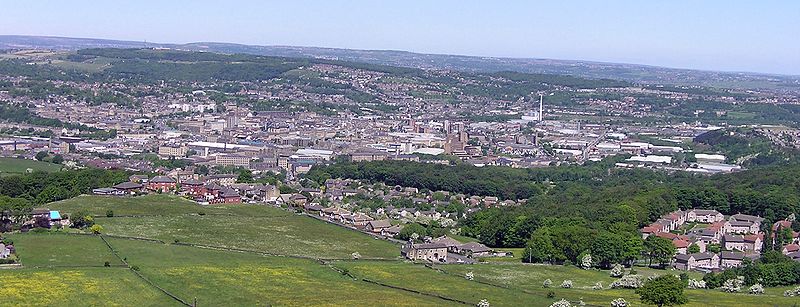
photo: Richard Harvey
One of the peculiarities of Huddersfield is that despite, with a population of 146,000, being considerably larger than many formally designated ‘cities’, it has never sought that city status. The good folk of Huddersfield seem content with their town-ness, and one wonders, what are the virtues of being a ‘town’ that they want to hang on to? (Inverness, are you listening?) For the past few months I’ve been a member of an External Advisory Group to the Scottish Government’s Town Centre Review, the report of which was published earlier this month. Inevitably, I don’t agree with everything that’s in the Review, but the process of working on it has been eye-opening.
Half of Scotland’s population live in its 500-odd towns, and yet those towns rarely seem to benefit from any specific and focused Government strategies or policies. There have been Six (and now Seven) Cities Initiatives, and I’ve spent most of the last 20 years focusing on rural initiatives, but towns often seem like poor relations, as if there was something inherently dull or old-fashioned about the very idea of a ‘town’–exactly the prejudice which Crane’s series is trying to overturn. It doesn’t help that the concept of ‘town’ is a wide and slippery one. Like Huddersfield some Scottish towns–Paisley, East Kilbride–are considerably larger than the three new cities of Inverness, Stirling and Perth, but there are also anomalies at the other end of the scale. I realised, writing this, that I have never actually lived in a town, although we’d spent twelve years in Anstruther, which is usually referred to as a village despite, with 3,600 people, being larger than many so-called towns.
Of course there are many handsome and prosperous towns in Scotland–St Andrews, Banchory and North Berwick are among those I know well–but the ‘problem’ towns are not confined to the obvious post-industrial areas such as Ayrshire or West Lothian. Rural Perthshire towns such as Crieff and Aberfeldy, for example, have suffered from the steady retreat of their commercial sectors, while many Border towns are affected by their ready access to the metropolises of Glasgow and Edinburgh.
That the arts can play an important role in reviving a flagging town has been amply demonstrated by Wigtown (book town), Kirkcudbright (art town) and West Kilbride (craft town), but also, without the need for such formal designations, by the development of cultural facilities, such as An Lanntair in Stornoway or the new Beacon in Greenock. But what some of us were trying to argue in the Town Centre Review is that a cultural approach to improving our towns needs to go much deeper. More technical interventions, such as changes to the process of business rates, or getting more town centre properties scheduled as residential, are only really going to be effective, we argued, if applied in the context of a thorough understanding of the different culture of each town—its history, how it grew up, the stories its inhabitants tell about it, what its young people think of it.
That after all is exactly Nicholas Crane’s thesis: that towns can be the machines for living in the future, that they can be capable of change and adaptation, but that you need to understand where each individual town is starting from to kickstart such change. For me, that message doesn’t come across quite strongly enough in the Review’s final report, but at least it’s a start. Now we just need someone with sufficient authority to take the Review’s recommendations and declare, in the immortal words of Jean-Luc Picard, ‘Make it so!’.
© Robert Livingston
The Wood and the Trees
Redundancy has its compensations. On Wednesday afternoon the clouds at last parted and some real, bright, life-enhancing sun broke through. No longer confined to an office (albeit one from which I could see Ben Wyvis) I took myself off for a walk in Reelig Glen .
When we first moved to the area in the mid 90s the walks in Reelig Glen were unsignposted, and mostly known about by word of mouth. A few years later it became a designated Forestry Commission walk, with roadsigns and information panels. I ought to approve of the greater access but I’m afraid I miss that sense of it being a rather secret place, and, of course, as it’s now advertised, FCS have to ensure that it’s also safe, which has taken away some of the wildness and the (very mild!) sense of adventure. But it is still breathtakingly, throat-catchingly beautiful.
Reelig Glen was a possession of the Frasers for 500 years until sold to FCS in 1949, and it owes much of its present appearance to one member of the clan, James Baillie Fraser, who planted the gorge of the Reelig Burn in the 1850s with specimens of the exotic trees being brought back by Scottish planthunters, such as David Douglas, whose eponymous firs are among some of the most spectacular (and tallest) trees in the Glen today. The upper slopes of the woods are now in the care of the local Community Woodland group, and include a beech ‘cathedral’ that is profoundly impressive at all times of year.

‘Glory be to God for dappled things’ wrote Hopkins, and there were plenty of dappled things in Reelig last Wednesday. I love the Glen at this time, when everything is at its most lush, green and overgrown, and the afternoon sunlight really brought out all the different, dense layers of foliage, especially where a break in the canopy opened up views across the gorge to the opposite slopes.
The trouble with writing a weekly blog is that you’re always on the look-out for material, and so as I trudged the paths I was wondering how I could tie this open-air experience into a blog about culture. True, I did have a heart-stopping Helen Mirren/The Queen moment when a doe broke cover about 20 yards ahead of me and stood still for a few moments, as we carefully regarded each other, but that’s not quite fertile enough blog material.
So I thought about why I like Reelig so much, of all the many lovely walks in the vicinity of Kirkhill, and I decided it was all to do with complexity. I take an intense, immediate, sub-verbal pleasure in the extraordinarily dense prospects available round each corner of the walk: the foliage and branch patterns of a dozen different types of tree, the overlapping effect multiplied by the slopes, and then the thick ground cover of the undergrowth. This is an effect, of course, that can be equally powerful in wintertime, with the added contrast of bare branches against evergreens.
It is complexity, not chaos. There are no less than three underlying levels of order. First, there is the original planting of over 150 years ago, and that has created a scaffolding on which a flourishing ecosytem now operates. And of course FCS staff apply discreet nips and tucks to keep paths safe and clear, and picturesque vistas open. So there are patterns at work here which, with enough information, could explain exactly why that one particular branch has grown in that direction and taken that shape.

And thinking about this made me realise how much I respond to complexity in art and music. I love paintings like Altdorfer’s The Battle of Issus in which, reputedly, no-one has yet counted how many figures are depicted, or poor, mad, Richard Dadd’s The Fairy Feller’s Masterstroke , or, closer to the Reelig experience, the paintings of Jackson Pollock. And I’m always drawn to dense counterpoint, whether in Renaissance polyphony, the fugues of Bach, or a Mahler symphony.
I’m also fascinated by composers for whom conventional instruments just don’t offer enough complexity, such as Conlon Nancarrow who would painstakingly punch holes in player-piano paper rolls to create pieces that sound as if they’re being played by ten hands at one piano, or Pierre Boulez, who combined the resources of a modern symphony orchestra with a whole additional layer of electronic sound in works like ‘Repons’. Judith finds such music instills in her a sense of panic, and I’m sure that’s not an uncommon reaction, but I find it exhilarating.
I wonder how far this is a modern phenomenon. After all, until Capability Brown introduced the concept of the picturesque into the planned landscape, parks and gardens were rigorously formal and orderly and, if complex, were so in a geometrically definable way. And it took the Romantic movement, spurred by Burke’s essay on the Sublime, to find beauty in rugged and natural landscapes that, in previous generations, would only have instilled fear and repulsion. Have we adapted, culturally, to cope with the increasing complexity of our modern world, and even to enjoy it, or have our brains actually developed a new ability to process such complexity (in the way that London cab drivers have been shown to have physical changes in their brains as a result of learning ‘the Knowledge’)?
Either way, it means that the kneejerk reaction of the average TV producer, to reach for some ‘English pastoral’ music to overlay images of places like Reelig Glen, may be downright wrong, and the rich complexity that sees apparent chaos emerging out of a variety of pattern sources, might be better represented by something like Elliot Carter’s Variations for Orchestra !
© Robert Livingston
A Cultural Compass Point
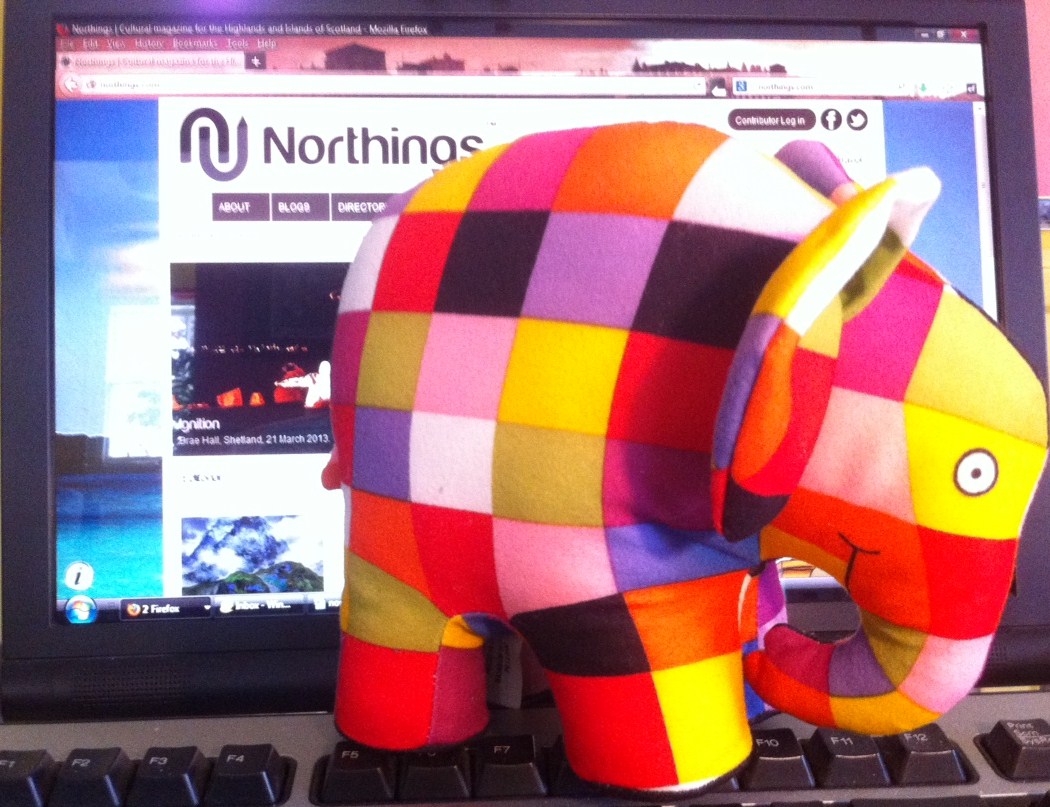
I started writing this as the last elements of HI~Arts were being shut down around me, computers being wiped, permanent out of office notices put on email addresses. But I’m not going to write about that. I want to flag up just one aspect of our 23-year history—the online arts magazine Northings.com.
It has been a perennial, and entirely justified, complaint that cultural activity in the north of Scotland doesn’t get the coverage it deserves in the national media. As newspaper budgets have shrunk, and local stringers have been cast off, that problem has, if anything, become more acute. Knowing that, I was also conscious of the transience of all such cultural activity, the lack of any permanent, public record of what happened, when, and what people thought of it. This had been forcibly brought home to me when I tried to find online any history of Glasgow’s Third Eye Centre, where I worked in the early 80s. One of the most significant cultural initiatives in Scotland in the last half century had virtually no online presence. Happily, that’s now being sorted, with a major research project under way to document all Third Eye’s archives, and those of its successor the CCA.
So Northings had two main aims: to tell the rest of the world what was happening now, and to build up a long term record for future readers of what happened then. In ten years Northings posted over 1700 reviews of events from Shetland to Argyll and Benbecula to Moray, and over 700 features on artists and arts companies working in the Highlands and Islands.
For a website with a contemporary focus, Northings.com was a defiantly old fashioned model. It was not ‘crowd-sourced’. It had the inestimable Kenny Mathieson as its editor for its entire ten year history, bringing a wealth of experience from the world of print arts journalism. All features and reviews were directly commissioned, and all the writers were paid a going rate for their work. Northings carried no advertising, so that there could be no suspicion of special pleading, although for a brief period we did flirt unsuccessfully with automated links to Amazon.
So, Trip Advisor for the arts this wasn’t. And I believe that that was what gave it its strength and credibility. Don’t get me wrong, I have huge respect for the power and the collective intelligence of crowd-sourced judgements. I use Trip Advisor regularly, and am often swayed by ratings on Amazon (other online retailers are available). But, for our purposes, crowd-sourcing had two drawbacks. First, for many of the events involved, there simply wouldn’t be a big enough critical mass of individual opinions and, secondly, we wanted to build a recognisable credibility for our individual writers, so that their positive reviews could become calling cards and marketing tools for the fortunate recipients. Of course, that meant that the negative reviews carried a similar weight, a factor that dismayed some of our subjects!
Hence the need for an experienced editor, who could guide writers new to the discipline, and apply the necessary (and often modest) subbing required. Hence also the avoidance of advertising—this was all about integrity and credibility.
Above all, what Northings gave its writers and readers was space-space to describe, analyse and reflect on a performance or an exhibition in depth and in detail; space, where appropriate, to provide context. Writers like Georgina Coburn in Inverness, Ian Stephen in Lewis, and Morag MacInnes on Orkney had the space to devote, if they wanted, 1,000 words or more to a review that, in the national press, would have barely merited 200. Again, that’s counter-intuitive. After all, the Web is supposed to be all about sound bites and a lack of sustained attention. But perhaps that’s just another untested assumption.
Technically, Northings is not a costly site, because being based on the estimable WordPress platform, it’s cheap to host and easy to use—our writers could use the ‘back end’ to post their reviews and features directly, leaving Kenny only to sub and approve them. The cost of course lay in the fees, to editor and writers. Nonetheless, the total budget was still less than that of a specialist publication such as the new writing journal Northwords Now. In its ‘tabloid’ format, free to pick up, Northwords Now produces 7,000 copies per edition, three times a year. Online Northings, by comparison, received around 6,000 unique visits for each of its monthly editions. So, as a means of disseminating knowledge, it was cost-effective.
Northings still exists. As part of the process of winding up HI~Arts we paid for an additional year’s hosting, to March 2014. Its huge archive of reviews and features, a unique picture of a decade’s cultural activity, will remain fully accessible and searchable throughout that period. So, if anyone out there has a vision for reviving Northings, in a way that will be faithful to its original concept, the gauntlet is thrown down—feel free to pick it up!
© Robert Livingston
2017: a long overdue update to flag up the excellent news that the Northings Archive is hosted by High Life Highland and fully accessible at http://northings.com . Huge thanks to High Life Highland for making this possible!
 the whole elephant
Recent Comments